
Most people have at least a few moles, freckles, bumps or other marks on their skin. Many of these spots are harmless and may remain unchanged for years. Others can appear with age, sun exposure, hormonal changes or irritation.
Although noticing a skin growth does not automatically mean something is wrong, it is important to pay attention to new or changing spots. Skin cancer and other medical skin conditions can sometimes resemble an ordinary mole, sore or irritated patch. A dermatology provider can examine the area and determine whether it should be monitored, treated or tested.
The ABCDE guide is a useful way to recognize changes that may need professional evaluation:
The “E” for evolving is especially important. A spot that looks different from your other moles or begins changing deserves attention, even when it does not meet every part of the ABCDE guide.
Not every concerning skin growth looks like a dark or irregular mole. Some skin cancers and precancerous growths appear as a pink bump, a rough patch, a sore that repeatedly crusts or an area that simply does not heal.
Schedule a dermatology appointment when you notice:
Dermatologists sometimes refer to the last example as the “ugly duckling” sign. Most of a person’s moles tend to share similar characteristics. A spot that stands apart in color, shape or size may warrant a closer look.
Yes. People of every skin tone can develop skin cancer. Although certain types are more common in people with lighter skin, no one is completely protected.
On darker skin, suspicious changes may be more likely to occur in areas that receive less sun exposure, including the palms, soles, nails or inside the mouth. This is one reason a complete skin check should include more than the face, shoulders and arms.
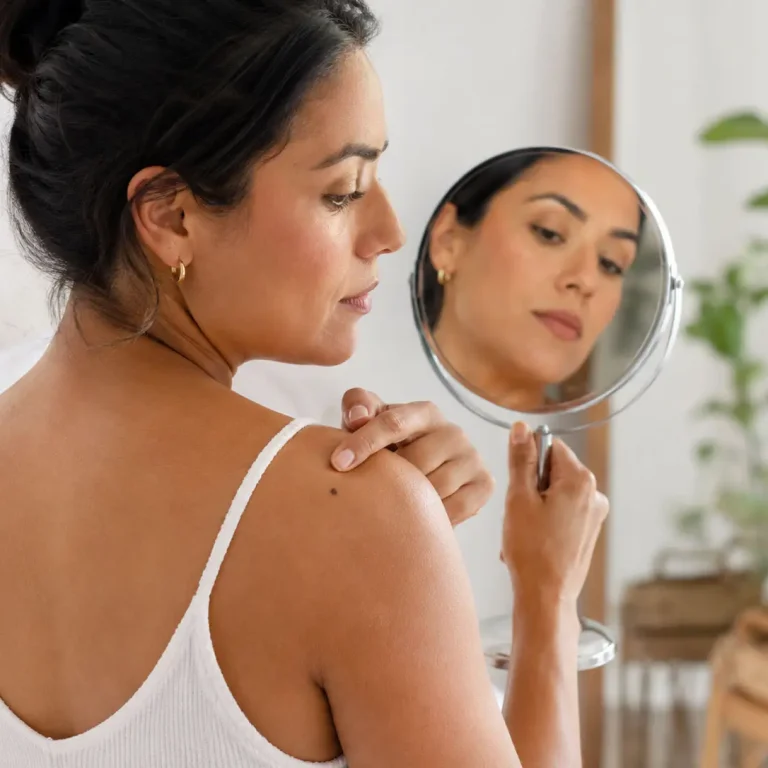
Regular self-checks can help you become familiar with what is normal for your skin. You do not need to diagnose anything yourself. The purpose is simply to identify changes that can be brought to a dermatology provider’s attention.
Choose a well-lit room and use both a full-length mirror and a handheld mirror. Examine:
A comb or hair dryer can make it easier to check the scalp. You may also ask a partner or family member to look at areas that are difficult to see.
Taking a clear photograph can help you compare a spot over time. Try to use similar lighting and distance each time. Photographs are useful for tracking changes, but they should not replace an examination when a growth is already concerning.
There is no need to wait until a spot becomes painful or dramatically different. Contact a dermatology provider when you notice a new, unusual or changing area — especially if it continues to evolve over several weeks.
You may also benefit from periodic professional skin examinations if you have:
Your provider can recommend an examination schedule based on your individual risk factors.
Your provider will first ask how long the spot has been present and whether it has changed, bled, itched or caused discomfort. The area may be examined with magnification or a specialized handheld instrument that provides a closer view of structures beneath the surface.
Many spots can be identified through examination alone. When the diagnosis is uncertain or a growth appears suspicious, a small sample may be taken for laboratory testing. This is called a skin biopsy.
A recommendation for biopsy does not mean that a growth is necessarily cancerous. It simply allows the tissue to be examined more closely so that an accurate diagnosis can be made.
Sun protection can help reduce additional ultraviolet damage. Choose a broad-spectrum, water-resistant sunscreen with an SPF of at least 30, apply it to exposed skin and reapply as directed — especially after swimming or sweating. Protective clothing, sunglasses, hats and shade provide additional protection.
Avoid intentionally tanning outdoors or in tanning beds. A tan is a sign that ultraviolet radiation has affected the skin, even when there is no visible sunburn.
Most moles and skin growths turn out to be benign, but appearance alone cannot always confirm what a spot is. An evaluation can provide reassurance when a growth is harmless and help ensure that a concerning condition is addressed promptly.
If you have noticed a new, changing or uncomfortable spot, schedule an appointment for a professional skin evaluation.
We would love to get started on a solution that perfectly fits your needs.